After the estradiol drop: collagen, ceramides, and the cream that knows its place
Reviews cite up to 30 percent dermal collagen loss across about five years after menopause. Lipid ratios can tighten the stratum corneum. They do not replace hormone therapy.
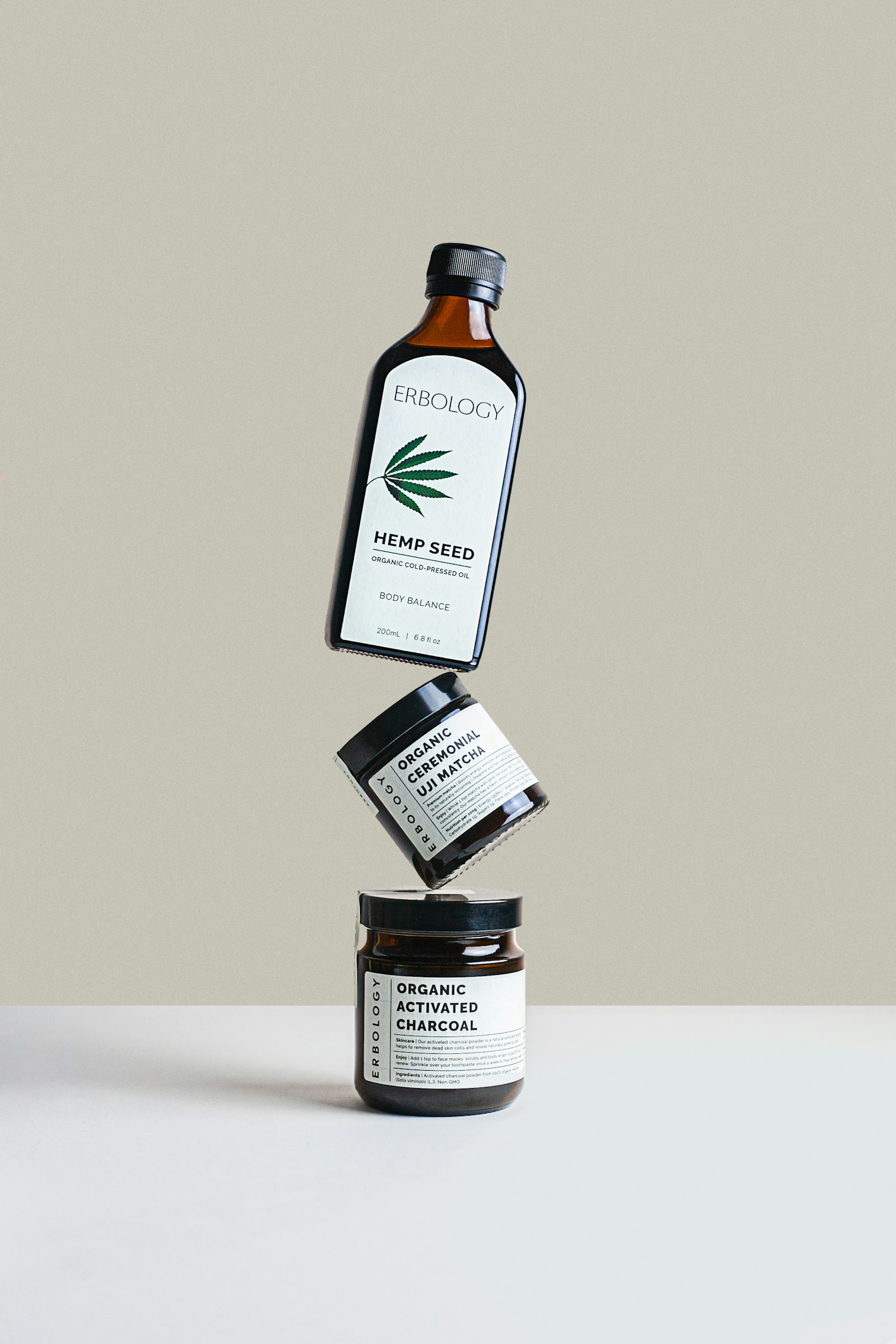
Quiet bottles in even studio light, the scale of care a clinic can actually hand someone. Image credit: Unsplash. Unsplash commercial licence.
In the first years after menopause the dermis can lose a large share of its collagen, and the figure dermatological reviews keep citing is up to 30 percent across about five years. It does not come from a cream study with flattering light. It comes from measurements on skin whose estrogen has fallen, including work that compared skin thickness and collagen content before and after the final period. 17-beta estradiol is the hormone in that story. It docks onto estrogen receptors in keratinocytes and fibroblasts and, by that route, takes part in directing hyaluronan, collagen and ceramide synthesis. A cosmetic term would be a demotion.
A cosmetic clinic does not replace hormone therapy. It does not prescribe estradiol, it does not stop it, and it does not diagnose menopause from a cheek. What it can do sits one level down and is still concrete enough to book. Set lipid ratios so a thinning barrier receives ceramides, cholesterol and fatty acids from the outside. Use phytoestrogens only where penetration and dose make a receptor interaction in skin plausible at all. Tell the client where the room ends and a physician begins. At the hormone workshops of the Kosmetikfachhandel in Munich, that last sentence is the rare one. The stands prefer the first, because the first has a pump.
What falls when 17-beta estradiol falls
As 17-beta estradiol falls, the epidermis thins, water content drops and sebum production eases off. Ceramides in the stratum corneum, especially longer-chain species that keep the barrier tight, become scarcer. The dermis loses collagen faster than in the years before, and the fibres that remain sit less orderly. Elastin and vascular reactivity shift alongside them. The visible picture is dry, more easily irritated, sometimes more marked in the lines, sometimes with a redness that feels new to the person wearing it. None of this may be labelled estrogen deficiency as a cabin finding. The client brings the context, a cycle, a last period, a therapy already underway, or she brings none of it. Both versions are written down. Interpretation stays out of the note.
Hormone therapy, where a physician prescribes it, can influence a share of these skin changes. That is medicine, with its own indication, its own risks and its own consent, none of which a facial menu inherits. A clinic that sells its care as an alternative to HRT is claiming an efficacy and a safety a cream does not have. A clinic that contradicts an ongoing HRT, or offers to replace it by a plant route, crosses the same line from the other direction. Care sits beside. The prescription stays in the practice that wrote it.
Up to 30 percent collagen in about five years describes a hormonal loss in the dermis. A ceramide cream keeps the stratum corneum tighter while that loss is underway. It does not refund the percentage.
The 30 percent is an order of magnitude from the literature. It is a poor number to write on one client’s forehead as a forecast. Age at menopause, years of sun, smoking, body weight and any therapy shift the course in ways a single facial cannot see. A price list that says 30 percent of the collagen back has reversed the direction of the studies. The figure describes a loss. Cosmetics do not issue refunds in collagen percent.
Ceramides while the dermis is losing ground
The practical answer from formulation is a lipid cream whose ratio of ceramides, cholesterol and free fatty acids resembles a disrupted stratum corneum. A light emulsion with a ceramide in trace is a different object, often a nicer one to wear, and a weaker one for the job. Several ceramide species, present as more than a single INCI line at the end of the list, plus cholesterol and fatty acids at a level the maker can actually support: that is the cream worth the conversation. Hyaluronan at various chain lengths puts water into the epidermis. Lipids are the sheets. A client who now tolerates only gels, because richer textures feel too heavy, often needs exactly the heavier texture, in a small amount, on slightly damp skin. The conversation is awkward. It is more useful than another water-rich serum with a soft name.
Retinoids remain a tool for the look of collagen and for epidermal turnover, with a limit that gets sharper in this phase of life. The barrier is thinner. The same concentration that was tolerated at 35 stings at 55, sometimes on the second night, sometimes as a surprise the client files under the product having changed. Frequency down. Set it on a stable lipid base. Stop when flaking no longer settles in a few days. A retinol that spends ceramides faster than the cream puts them back works against the lever the clinic actually holds.
Photoprotection is the other lever, because UV years and estrogen years add up in the same collagen. A hormone story without UVA cover is an unfinished sentence. UV damage is the larger of the two injuries you can influence every day without writing a prescription, and it is the one a cabin can actually see the client do, or skip, on the way out.
- Dermatological reviews describe up to 30 percent collagen loss in the dermis across about five years after menopause.
- 17-beta estradiol, via receptors in skin, takes part in directing hyaluronan, collagen and ceramide synthesis.
- A cosmetic cabin does not replace HRT, does not stop it, and does not diagnose menopause from texture.
- Ceramide, cholesterol and free fatty acids in a real ratio support the stratum corneum. The lost dermal percentage stays a medical figure.
- Phytoestrogens bind weakly, when they bind, and only with enough penetration. A plant name on a label is a name.
Phytoestrogens, as a dose or as a label
Isoflavones such as genistein, and stilbenes such as resveratrol, are discussed as plant ligands that can bind weakly to estrogen receptors in skin, with a relative lean toward ER-beta in parts of the literature. Weak means distant from 17-beta estradiol, by orders of magnitude that marketing prefers to round off. A cream with soy extract in an unstandardised amount often delivers too little genistein for that path to be reached at all. At the workshops in Munich, milligrams per gram and a penetration model belong in the supplier conversation, asked before the sample is rubbed in. If both are missing, the ingredient is a botanical label with a hormonal story and a pleasant colour.
Even at a documented concentration the claim stays narrow enough to bore a copywriter, which is how you know it might be true. Care for skin that is getting drier and thinner. Hormone replacement stays a medical category. Statements about breast, uterus or bone that reach past the skin stay out of the cabin entirely. A clinic does not recommend phytoestrogens as a safe alternative for women who avoid HRT or must not receive it. That decision is made in a medical consultation, with a history the facial chart does not hold. The cabin records what the client says and stays with the barrier. Essential oils sold as hormonally balancing irritate a thin barrier. The balancing they advertise cannot be measured on a cheek, which makes them expensive irritation.
Physician and clinic, on the same afternoon, in different rooms
A usable offer has a shape you can say without a diagram. A lipid care with named ceramides and a real share of them, morning and night, photoprotection in the morning. Optionally, a phytoestrogen leave-on at a declared level, at night, on the lipid care or under it, according to the maker’s release. And a sentence that is actually said, in the room, at a normal volume: if you want to talk about hormone therapy, that is a conversation with your physician. We care for the barrier. The other conversation has a different door.
Up to 30 percent collagen in five years is a reason to rebuild the care and to take the client seriously when she says her skin changed faster than her products did. It is a poor reason to declare a cream a therapy. The dermis loses what the hormone no longer holds. The stratum corneum can still be made tighter, with lipids you can name and a filter you can see her apply. That is the work of this beat, and it is enough work for a price list that wants to stay true.