Red and near infrared after a peel: dose, distance, cytochrome c oxidase
Photobiomodulation around 630 and 850 nanometres meets complex IV. Fluence, goggles and the photosensitiser question belong in the aftercare sheet, not in a reel.

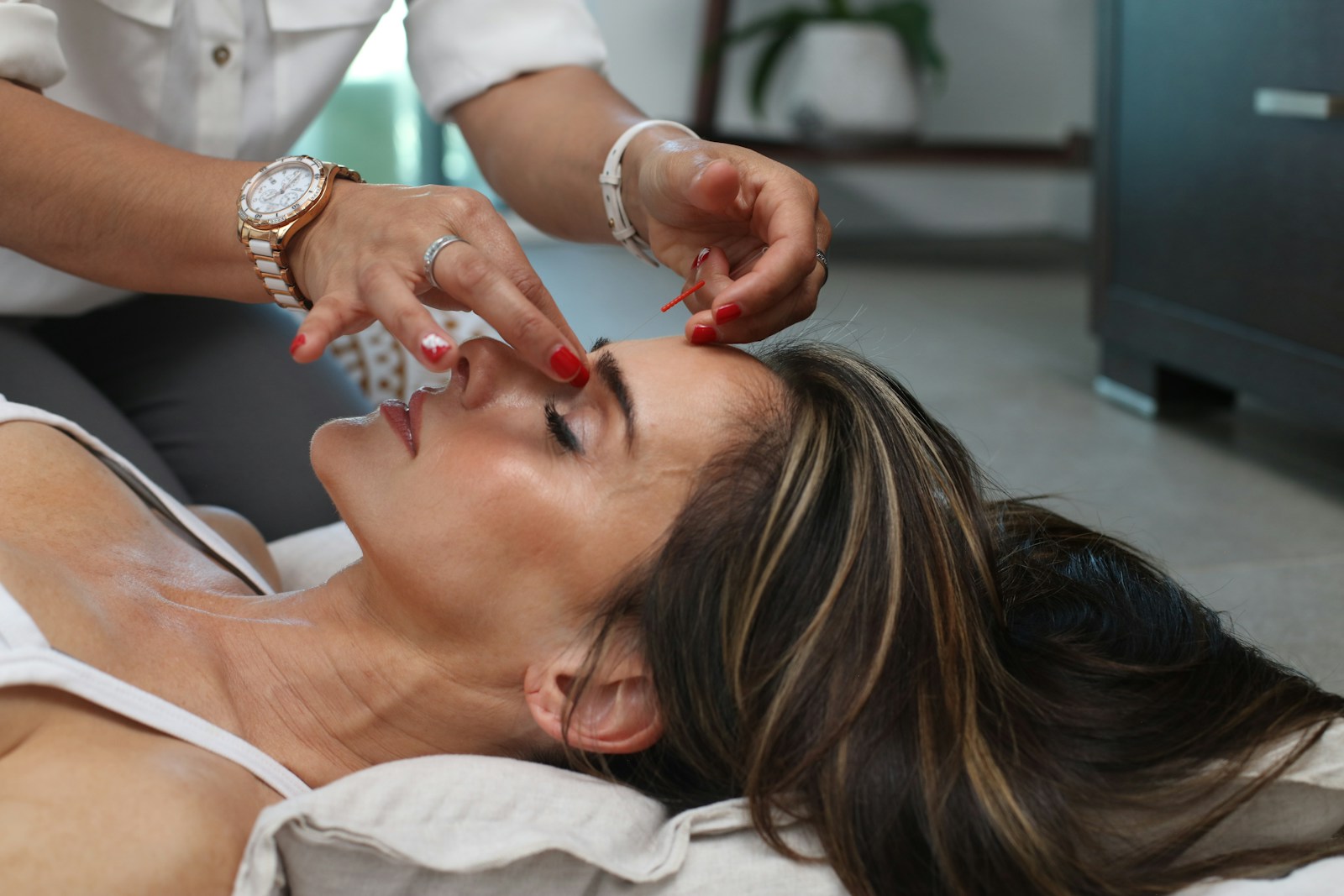
Clinical light in an aftercare room, where brightness is a measurement and not a mood. Image credit: Unsplash. Unsplash commercial licence.
Photobiomodulation, still called low-level laser or simply red light in many rooms, is the delivery of red and near-infrared light at doses that leave tissue uncut and uncoagulated. The best-studied chromophore in the respiratory chain is cytochrome c oxidase, complex IV. Photons in the red, around 630 to 660 nanometres, and in the near infrared, around 810 to 850 nanometres, are absorbed by that enzyme. In cell models the redox state shifts, nitric oxide can leave the binding site, and ATP turnover changes. That is the mechanism worth saying slowly to a client who asks what the mask is for. A reel in which a panel promises 200 percent more collagen is a caption. Collagen does not read captions.
After an ablative laser or a medium peel, skin is a wound surface with a higher energy demand and an inflammatory phase. More heat is a clumsy answer to that phase. This is where PBM is discussed in medical aesthetics as aftercare: less redness in some series, faster closure of the outer layer, a quieter course in the first days, at doses someone wrote down. In professional retail at the Kosmetikfachhandel in Munich the panels still stand as a freestanding anti-aging device with a membership attached. A dose that may make sense after a procedure is a specific dose. Dropping it on intact skin three times a week because the diary has a gap is how the biphasic curve gets ignored by a calendar.
630 and 850 are different depths
Red light around 630 nanometres is absorbed more superficially. It stays closer to the epidermis and upper dermis. Near infrared around 850 nanometres scatters deeper and reaches structures red light barely still sees. A device that mixes both wavelengths treats two depths at once, and only if both arrive at a meaningful irradiance. Irradiance, in milliwatts per square centimetre, and time together give fluence in joules per square centimetre. Without those two numbers, twenty minutes of red light is a mood with a plug. It is a weak protocol, and it is an easy one to sell because the room looks expensive while it happens.
The dose response of PBM is treated as biphasic, which is the fact that spoils the upsell. Too little, and nothing measurable happens. A window in the middle is where studies show the cellular effects described above. Well above that, the same wavelengths can inhibit or irritate. More lamps and more minutes are therefore a poor synonym for more aftercare. A peel that has already opened the barrier tolerates a different fluence from an intact cheek on a Monday morning. Makers who give one time for every indication have left the biphasic curve in the paper and printed a single number because it fit the remote.
Distance belongs in the same sum, and clients move. Light falls off with distance, politely and completely. A mask sitting on the skin delivers a different irradiance from a panel with a client in a chair, sometimes upright, sometimes leaned back, sometimes checking a phone. In trade buying the mask is pressed to a face and the panel is shown at 30 centimetres. Back in the clinic one of those two values has to be fixed, or fluence is a coincidence from one appointment to the next. You measure it with a proper meter head. Brightness, as the eye judges it, is a liar. Near infrared is hardly visible. It still acts, which is why goggles exist.
After laser and peel, a window with rules
In the hours after a non-ablative or lightly ablative procedure the question is whether light can modulate the inflammatory phase without adding heat. PBM devices that stay properly cool can be used in that window if the intended purpose names aftercare and the skin is no longer openly bleeding. A fresh, weeping area is the wrong stage for a demo unit that lived on a sales floor. Cooling, rest and the care the procedure protocol already specifies come first. Light is an addition with a job. Wound care remains the job that was already written.
Cytochrome c oxidase absorbs around 630 and around 850 nanometres. Fluence decides whether that meeting becomes a shift in ATP turnover or merely a red room.
The literature and the cabin stay in separate folders when you read them properly. There is work on faster re-epithelialisation and less erythema after aesthetic procedures, at defined wavelengths and doses. There is also work that finds no difference, which is inconvenient for a reel and useful for a clinic. You use the dose that belongs to your own device, or you drop the claim. A sentence about supporting the look of skin while it settles can stand if the device’s purpose supports it. Healing a laser ablation is a medical verb. A lamp does not earn it by being red.
Photosensitisers are the gap that hurts people, and they hide in ordinary medicines. Clients after photodynamic therapy, or on medicines and plants that raise light sensitivity, stay out from under an extra panel because a diary said aftercare. The clinic does not prescribe those medicines and does not stop them. It asks, and it postpones light if the answer is yes. St John’s wort, certain antibiotics, some acne medicines and some cardiac drugs appear on manufacturer lists. The list applies on a Friday the same way it applies on a Monday, including when the client is in a hurry to look settled for a photograph.
- Complex IV, cytochrome c oxidase, is the central chromophore for red and near infrared in the PBM literature.
- About 630 to 660 nanometres stay more superficial. About 810 to 850 nanometres go deeper. Swapping the numbers swaps the depth.
- Fluence in joules per square centimetre comes from irradiance and time. Distance turns that sum into a guess when it is left unfixed.
- The dose-response curve is biphasic. Extra minutes can leave the window where the cellular effect was described.
- After a peel or a laser, intended purpose and the photosensitiser question both apply. A reel replaces neither, however flattering the colour grade.
What does not fit in a caption
Serious instructions for use exclude known malignancy in the treatment area, and they exclude direct exposure of the eyes. Near infrared passes thin eyelid skin with very little ceremony. Goggles matched to the wavelength are equipment. Pregnancy is excluded by many makers because cosmetic aftercare is a weak reason to run an unsettled risk, even when a single dramatic data point is missing from the file. Epilepsy and light sensitivity appear on some lists, especially when the device uses visible pulsed light. If the list is absent from reception, the device has not been introduced. It has been plugged in, which is a different milestone.
If the intended purpose is silent on children and adolescents, you leave them off the chair. Photographs beside the masks In trade buying are advertising. An indication is a document. The two get confused in aisles where the light is pretty and the type is small.
Intact skin with no procedure behind it deserves its own dose, or it deserves none. Daily high-dose sessions sold as longevity walk out of the biphasic window. Some users leave dry and headachy. A fibroblast does not build collagen faster because a membership renewed. If the house offers PBM, it offers it with an end: aftercare after a named procedure, fixed fluence, fixed series, a stop you can point to. Open-ended memberships with no dose are a subscription. Photobiomodulation is the thing with the joules.
Three figures, then the lamp is either a protocol or a lamp
Three figures decide the buy, and they are dull enough to trust. Wavelengths, measured, beyond the LED bin note from the diode maker’s sheet. Irradiance at the treatment distance, with a measurement record no older than the current generation of the device. The intended purpose, which either names aftercare after aesthetic procedures or does not. If the third is missing, the panel is a lamp. Lamps may be sold. They stay off the clinic menu as cytochrome therapy, which is a phrase that should make a buyer slightly tired.
In the treatment room a sheet hangs that a substitute can read on a busy Thursday. Wavelength. Distance. Minutes. Joules per square centimetre. Which procedure. From which day after. When you stop. Eyes closed, goggles on, photosensitisation asked before the panel is swung into place. That is the whole protocol, and it fits on half a page. Cytochrome c oxidase is indifferent to the caption. It answers photons, in a number, at a distance you bothered to keep still.